
What Employers Really Look for When Hiring in 2026

Sarah Mitchell
February 3, 2026

Employers in 2026 prioritize skills over traditional qualifications like degrees or years of experience. With 81% of companies now using skills assessments, hiring focuses on what candidates can actually accomplish. Key trends include the rise of AI in recruitment - 84% of talent leaders use it - making an AI resume builder an essential tool for modern candidates - and the demand for both technical and interpersonal skills. Analytical thinking, AI literacy, and emotional intelligence (EQ) are among the most sought-after abilities. To stand out, candidates should demonstrate proven skills, a willingness to learn, and alignment with company goals. Tools like scale.jobs can help streamline job applications with AI and human expertise, ensuring your resume meets modern hiring standards by optimizing for ATS.
2026 Workforce Trends To Watch
Skills Employers Want Most in 2026
Top Skills Employers Want in 2026: Technical vs Interpersonal Abilities
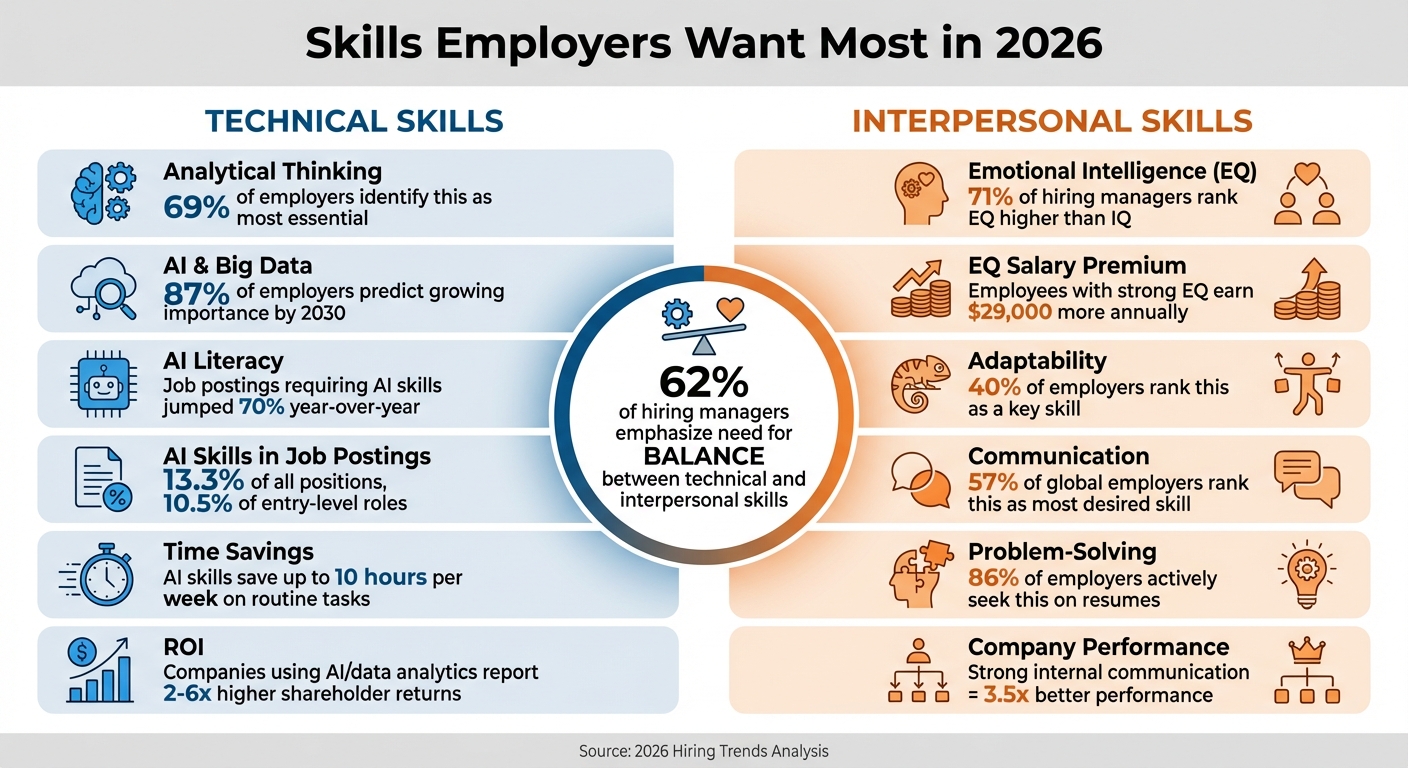
The abilities that will matter most in 2026 fall into two main areas: technical expertise for working with modern tools and interpersonal skills that bring a human touch to the workplace. Both are equally important - 62% of hiring managers emphasize the need for a balance between these two skill sets.
The shift in priorities is undeniable. Analytical thinking stands out, with 69% of employers identifying it as the most essential skill for their workforce. AI and big data skills are not far behind, with 87% of employers predicting their growing importance by 2030. On the interpersonal side, emotional intelligence (EQ) is emerging as a game-changer. In fact, 71% of hiring managers rank EQ higher than IQ, and employees with strong EQ earn an average of $29,000 more annually than their peers.
This reflects a broader trend where proven abilities now hold more weight than traditional qualifications. Let’s dive into the specific technical and interpersonal skills that will shape hiring decisions in 2026.
Technical Skills: AI and Data Analytics
AI literacy has become as essential today as Excel proficiency was a decade ago. Employers are no longer just looking for traditional data scientists - they want professionals who can use AI resume tools to plan, draft, and streamline workflows. Job postings requiring AI skills have jumped by 70% year-over-year, with 13.3% of all positions - and 10.5% of entry-level roles - explicitly listing these skills.
What’s driving this demand? Companies now value the ability to perform "structured, multi-step prompting" with AI. Instead of relying on single, one-off queries, they seek people who can guide AI tools through a series of instructions to refine and improve outputs. This skill can save professionals up to 10 hours each week on routine tasks, and businesses leveraging AI and data analytics report two to six times higher shareholder returns compared to competitors.
"AI literacy has become as basic as Excel was back in the day. Companies want people who can work with data on their own." - CareerKit
Modern roles also require strong data interpretation skills - using dashboards, identifying patterns in metrics, and making evidence-based recommendations. Proficiency in tools like SQL, Python, Tableau, and Power BI is essential. Additionally, cloud computing skills, especially with AWS, Azure, or Google Cloud, are now seen as fundamental. Cybersecurity knowledge, once confined to IT departments, is becoming a must-have across various roles.
While technical expertise is critical, the ability to collaborate, lead, and adapt is just as valuable.
Interpersonal Skills: Flexibility and Leadership
As automation takes over repetitive tasks, adaptability has become a top priority. About 40% of employers rank adaptability as a key skill, yet 63% of leaders say they struggle to find candidates who handle change effectively. Employers are also prioritizing "learning agility" - the capacity to quickly pick up new tools and adjust to shifting priorities without losing momentum.
Leadership in 2026 is less about having a formal title and more about the ability to inspire, organize, and influence others toward shared goals. Behavioral interviews now often include leadership-focused questions, with 55% of employers assessing how candidates resolve conflicts and manage stakeholders.
"The most valuable employees won't be the ones with the longest resumes; they'll be the ones who can think, learn, communicate, and make decisions in a world where AI is part of every workflow." - Natalie Lemons, Founder and President, Resilience Group, LLC
Strong communication skills are also in high demand. In hybrid work settings, clear and effective digital communication is treated like a technical skill. Employees must excel at asynchronous collaboration and concise writing. Companies with strong internal communication perform 3.5 times better than their peers, and 57% of global employers rank communication as the most desired skill for future hires. Problem-solving is another standout, with 86% of employers actively seeking this skill on resumes.
Teamwork and Diversity Awareness
Diversity awareness has transitioned from a nice-to-have to a core business need. Companies are now prioritizing candidates who understand and value diversity and inclusion. Diverse teams are proven to drive innovation, and businesses need products and services that resonate with a global audience - something only a variety of perspectives can achieve.
"Diversity of thought leads to solutions that truly resonate. If the people designing products... can't relate to their perspectives, there's a real risk that offerings will miss the mark entirely." - Bianca Stringuini, Global Inclusion Lead, The Stepstone Group
To stand out, highlight your experience working in cross-functional and diverse teams, showcasing how your contributions made a meaningful impact.
What Employers Look for Beyond Skills
While technical expertise and interpersonal abilities might get your foot in the door, employers in 2026 are digging deeper. They’re not just hiring for what you can do today - they want to know if you’ll grow with the company, adapt to change, and thrive in their environment. With the cost of a poor hire climbing higher than ever, businesses are focusing on retention and long-term potential. It’s no longer just about skills; it’s about how you fit and how you’ll evolve.
Company Fit and Employee Retention
Finding candidates who align with company values and goals has become a top priority. Employers are moving beyond traditional credentials, using data and competency-based approaches to assess cultural fit. Why? Because mismatched hires lead to quick turnover, disrupting teams and wasting resources.
A telling statistic: 36% of employees leave jobs due to a lack of professional development or training opportunities. This highlights why companies are keen on hiring individuals who not only align with their mission but can also thrive in their environment. To gauge this, employers often rely on behavioral interview questions that explore how you handle conflict, collaborate across teams, and respond to feedback.
To stand out, research the company’s values and prepare examples using the STAR method (Situation, Task, Action, Result). Show how your past actions align with their goals. For instance, share how you’ve resolved workplace challenges, contributed to team success, or adapted to organizational changes. If you’re unsure how to position your experience effectively, consider using professional resume writing services to craft a resume that resonates with specific employers.
Willingness to Learn and Grow
Beyond cultural fit, employers are looking for candidates with a hunger to learn and adapt. With industries evolving rapidly, learning agility - the ability to acquire new skills and adapt quickly - is often valued more than years of experience. By 2030, 50% of workers will need reskilling, and nearly 40% of core skills will shift, making adaptability a must.
"The individuals who thrive won't be the ones with perfect resumes. They'll be the ones who can say: 'I can evolve as fast as this industry does.'" - Natalie Lemons, Founder and President, Resilience Group, LLC
Employers now expect candidates to embrace change and master new tools without missing a beat. On your resume, highlight examples where you’ve adapted to new systems or shifting priorities using a "Before → Pivot → Result" format. This approach showcases how you’ve navigated change and delivered results.
Additionally, companies are investing in internal mobility, offering upskilling opportunities to retain talent and maintain a consistent workplace culture. Demonstrating your commitment to ongoing growth - whether through online courses, micro-credentials, or examples of leveraging AI tools for efficiency - signals that you’re ready to grow alongside the company, making you a long-term asset rather than just a temporary hire.
How to Match What Employers Want in 2026
Understanding employer expectations is only part of the equation; showcasing your ability to meet them is where the real challenge lies. With 97% of Fortune 500 companies relying on AI-driven screening tools, your application needs to appeal to both algorithms and human recruiters. Here’s how you can align your approach with hiring practices expected in 2026.
Creating ATS-Compatible Resumes
Your resume may never land in front of a recruiter if it fails to pass the Applicant Tracking System (ATS). These systems scan for specific keywords and formatting, and 80% of resumes need a job match score of 80% or higher to progress to the next stage. To boost your chances, stick to clear and standardized formatting.
- Use standard headers like "Work Experience", "Education", and "Skills" instead of creative alternatives like "My Journey."
- Stick to readable fonts such as Arial, Calibri, or Times New Roman in size 11 or larger.
- Avoid complex formatting like graphics, tables, or images, which can confuse ATS software.
Tailor your resume by incorporating exact terms from the job description, especially for technical skills. Modern AI screening tools evaluate not just keywords but also "skills adjacency" and context. For instance, if you’re a construction manager transitioning to tech, your experience in stakeholder coordination might be recognized as relevant for operations roles.
Replace traditional objective statements with an Impact Summary that highlights your value immediately. Use the "Action + Context + Measurable Result" formula to make your achievements stand out. For example, instead of saying, "Managed accounting processes", say, "Streamlined month-end close from 7 days to 5 days by automating reconciliation workflows, saving 16 hours monthly."
Consider adding a "Skills Matrix" to your resume. This section categorizes your skills into areas like technical tools, soft skills, and industry expertise. For AI-related skills, go beyond listing "AI" by demonstrating specific applications. For example: "Used ChatGPT to draft client proposals, refining outputs through iterative prompts, which reduced review time from 26 to 2 hours."
If you're unsure whether your resume meets ATS standards, professional services like resume writing services can help optimize it for both AI and human reviewers, ensuring it meets the necessary match threshold.
Once your resume clears the ATS, take it a step further by showcasing your work in an online portfolio.
Building an Online Portfolio
A resume tells your story; a portfolio proves it. In 2026, 65% of organizations will prioritize skills over traditional credentials, making tangible evidence of your abilities essential.
Start by creating a skills inventory that breaks down your capabilities into specific, industry-relevant categories. Then, showcase diverse examples of your work, such as:
- GitHub repositories for coding projects
- Design portfolios with before-and-after visuals
- Case studies explaining complex problem-solving
- Published articles that highlight your expertise
Highlight projects involving AI-augmented workflows. For example, describe how you used generative AI to draft marketing content and then refined it for tone and accuracy. Or explain how you built predictive models using AI tools to analyze customer data and guide strategic decisions. This demonstrates your ability to collaborate with AI tools effectively.
Don’t forget to include interpersonal skills. Use project summaries to illustrate how you handled challenges like resolving conflicts or leading cross-functional teams. Instead of listing "communication" as a skill, provide a case study: "Mediated between engineering and marketing teams to align product messaging, resulting in a 25% increase in campaign engagement."
Adding micro-credentials to your portfolio can further strengthen your application. Certificates from platforms like Google, IBM, or Meta are highly regarded by employers - 88% believe they enhance a job application, and 90% are willing to offer higher salaries to candidates with verified credentials. Use blockchain-based systems or tamper-proof links to ensure credibility.
Keep your portfolio up-to-date by auditing it quarterly. Remove outdated projects, highlight recent accomplishments, and share your journey on platforms like LinkedIn to increase visibility.
Preparing for Behavioral Interviews
Once your resume and portfolio are ready, the next step is acing behavioral interviews. These interviews are designed to verify the skills and achievements you’ve claimed. With the average number of interviews per hire increasing by 33% since 2021, preparation is key.
Use frameworks like the STAR method (Situation, Task, Action, Result) or PAR method (Problem, Action, Result) to structure your responses. These methods help provide clear examples of your problem-solving and leadership abilities. For instance, if asked about adaptability, you could say:
"Before the pandemic, our team relied heavily on in-person collaboration. When we transitioned to remote work, I implemented daily stand-ups via Slack and introduced Asana for project tracking. As a result, our team maintained 100% on-time delivery rates and reduced meeting time by 40%."
Employers also value learning agility, especially with 50% of workers needing reskilling by 2030. Share stories that show how you quickly mastered new systems or tools, and back them up with measurable results. For example: "Adopted a new contract management platform, reducing review time from 26 to 2 hours."
Demonstrate your AI literacy by explaining how you’ve used AI tools to enhance your work. For example: "I used ChatGPT to identify gaps in my project plan by asking it to 'interview' me about my goals. This helped me anticipate stakeholder concerns and refine my approach."
Interpersonal skills are just as critical. Research shows 71% of hiring managers prioritize emotional intelligence over IQ, and 77% consider communication skills vital. Prepare examples that showcase how you simplified complex ideas, resolved team conflicts, or mentored colleagues. Always tie these stories to measurable outcomes, such as improved productivity or faster project completion.
While practicing your responses, avoid memorizing scripts. The goal is to sound prepared yet natural, proving you’re ready to contribute from day one. Behavioral interviews are your chance to show you’re more than just a qualified candidate - you’re the right person for the job.
Using Tools to Improve Your Job Search
A well-designed job search platform can save you over 20 hours of application time each week while helping you secure interviews more efficiently. With 89% of candidates favoring hiring processes that include skills-based assessments and 66% admitting that their experience during hiring influences whether they accept an offer, it's essential to choose a tool that balances speed and quality.
Most platforms fall into two categories: job search automation bots that risk triggering employer filters or self-service tools that require extensive manual effort. Striking the right balance is crucial, especially since 26% of applicants decline offers due to poor communication or unclear processes. Here's a closer look at how key platforms compare.
Job Search Platform Comparison
Take a look at the feature breakdown for 2026:
| Platform | ATS Optimization | Human Support | Pricing Model | Work Verification |
|---|---|---|---|---|
| scale.jobs | Yes (Human-verified) | Yes (Human Assistants) | One-time Payment | Real-time WhatsApp Updates |
| Jobscan.co | Yes (Software-based) | No (Self-service) | Subscription | N/A |
| Rezi.ai | Yes (AI-generated) | No (AI-only) | Subscription/Freemium | N/A |
| Lazyapply.com | Limited | No (Bot-based) | Subscription | N/A |
The real difference lies in how applications are handled. While bots may trigger automated filters, platforms lacking human oversight can leave you stuck with repetitive tasks. This table highlights the advantages of scale.jobs, which combines technology with human expertise for a more effective approach.
Why scale.jobs Is Different
scale.jobs goes beyond basic ATS optimization by ensuring your application aligns with recruiters' evolving expectations. Its unique "human-in-the-loop" approach blends AI-driven efficiency with the precision of real people managing your applications. Unlike bot-only services that risk detection by employers, scale.jobs employs trained assistants to manually submit your applications to ATS systems and specialized job boards. This method minimizes the pitfalls of automation while ensuring your materials are seen by actual decision-makers.
Another major advantage is the pricing model. Instead of recurring subscriptions, scale.jobs offers one-time payment bundles, eliminating hidden fees or monthly renewals. This straightforward structure makes it easier to manage your budget.
Real-time updates set scale.jobs apart. Through WhatsApp, you’ll receive time-stamped proof-of-work screenshots, so you always know where and when your applications have been submitted. This level of transparency addresses the communication gaps that often frustrate job seekers and drive them away from opportunities.
If you're managing a high-volume job search while balancing interviews and networking, consider using professional resume writing services to refine your documents before your assistant begins submitting applications.
"In 2026, the highest salaries will go to the people who can make AI more valuable - not by replacing the human element, but by elevating it." - Penny Zenker
This principle applies to job hunting as well. The best results come from tools that amplify human effort rather than solely relying on automation.
Conclusion: Getting Ready for Hiring in 2026
The job market in 2026 is shifting its focus - skills are taking precedence over traditional credentials. With 65% of organizations emphasizing specific competencies rather than degrees, showcasing expertise in areas like AI literacy, analytical thinking, and emotional intelligence will be critical. Employers are seeking professionals who can utilize AI tools effectively while applying sound human judgment to tackle complex challenges. The key is turning these insights into a well-thought-out application strategy.
To stay competitive, ensure your resume aligns with ATS (Applicant Tracking System) standards. Since 70% of recruiters face challenges finding candidates with the right skills, it’s vital to quantify your achievements using the PAR (Problem-Action-Result) method, incorporate keywords from job descriptions, and highlight practical examples of AI integration in your work. With 39% of workers' core skills expected to evolve by 2030, your readiness to learn and adapt will be just as important as your current qualifications.
"By 2026, the most valuable employees won't be the ones with the longest resumes; they'll be the ones who can think, learn, communicate, and make decisions in a world where AI is part of every workflow." - Natalie Lemons, Founder and President, Resilience Group, LLC
To put this advice into action, focus on refining your skills and tailoring your applications. Consider leveraging professional resume writing services to meet the hiring standards of 2026. Platforms like scale.jobs combine human expertise with AI tools to create resumes that stand out, offering features like real-time WhatsApp updates and a one-time payment model. These services save you time, allowing you to concentrate on networking and preparing for interviews.
The "Great Thaw" of 2026 is bringing fresh opportunities, but with 82% of candidates who reach the offer stage accepting it, companies are more selective than ever. By adapting quickly and demonstrating your ability to thrive in an AI-driven world, you’ll position yourself as a standout candidate in a market where mid-level professionals with proven adaptability are in high demand.
FAQs
What skills will employers prioritize in 2026?
In 2026, employers will prioritize a balance of technical skills and soft skills to address the needs of a workplace shaped by constant change. On the technical side, expertise in AI tools, data analysis, and proficiency with dashboards and other data-centric platforms will be in high demand. These skills reflect the increasing reliance on technology across industries.
Equally important will be soft skills such as effective communication, critical thinking, and the ability to adapt to new challenges. As businesses continue to integrate AI into their operations, they’ll seek employees who can learn quickly, solve problems creatively, and work well both independently and as part of a team.
The ideal candidates will be those who can seamlessly blend technical know-how with strong interpersonal abilities, making them well-equipped to succeed in a fast-paced, technology-driven job market.
How can you showcase AI skills effectively on your resume?
To present your AI skills effectively on your resume in 2026, balance technical expertise with real-world applications. Be specific about your capabilities, such as generative AI, machine learning, data analysis, or automation, and highlight your hands-on experience with AI tools or platforms. For instance, mention your proficiency with AI-powered analytics software or automation frameworks you've worked with.
It's also important to show that you can excel in AI-driven environments. Highlight transferable skills like problem-solving, critical thinking, and adaptability to new technologies. Adding certifications, AI-related coursework, or projects you've completed can further strengthen your qualifications. Tailor your resume to reflect how your AI knowledge meets the needs of a forward-thinking workplace.
Why do employers prioritize emotional intelligence over IQ in hiring?
In 2026, employers are placing greater emphasis on emotional intelligence (EQ) than IQ. This shift highlights the importance of qualities such as resilience, empathy, social awareness, and the ability to adapt. These skills are becoming crucial for fostering teamwork, effective leadership, and navigating the increasingly complex interpersonal challenges of today’s workplaces.
While technical skills and IQ still hold value, EQ plays a pivotal role in helping employees build strong relationships, resolve conflicts, and communicate clearly. These abilities are essential for encouraging collaboration and sparking innovation in fast-paced work environments. Employers are recognizing that a high EQ not only benefits individual performance but also drives organizational success.