
Why Applying on Job Portals Alone Is Slowing Down Your Job Search

Sarah Mitchell
February 4, 2026

Applying solely on job portals like LinkedIn or Indeed might feel convenient, but it’s often an inefficient way to land a job. Here's why:
- Low Response Rates: Platforms like LinkedIn and Indeed have an average interview response rate of just 4%. Many applications get filtered out by automated systems before reaching a human.
- ATS Challenges: Applicant Tracking Systems (ATS) reject up to 63% of resumes due to formatting or missing keywords, leaving even qualified candidates overlooked.
- Oversaturation: With 90% of job seekers using these portals, competition is fierce, and resumes often get buried under hundreds of submissions.
- Generic Applications Fail: One-click submissions lack personalization, making it harder to stand out to recruiters.
Instead, strategies like networking, directly applying through company career pages (which have an 11.2% response rate), and using human-assisted services like scale.jobs can significantly improve your chances. These approaches help bypass ATS filters and ensure your applications are tailored to each role.
This article breaks down actionable tactics, comparisons of application tools, and why personalized methods outperform generic submissions.
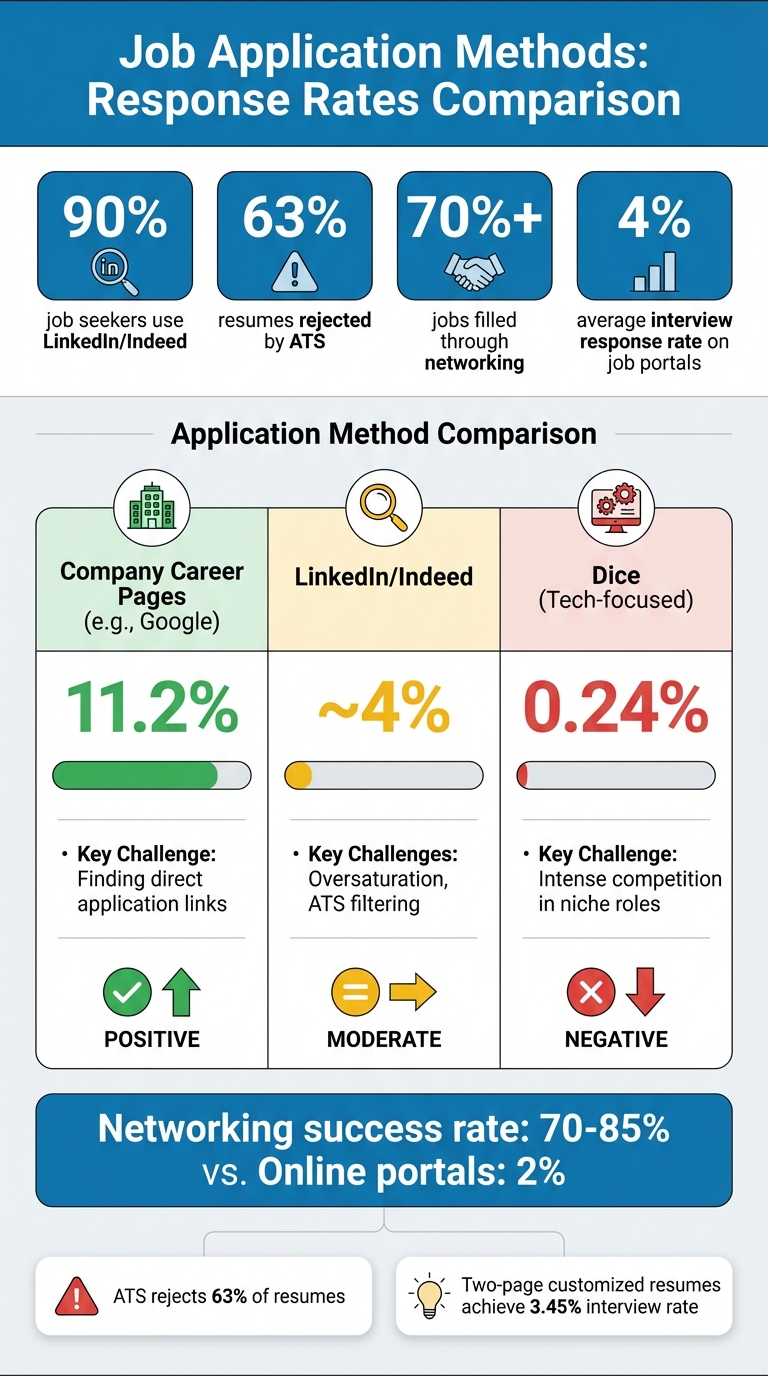
Job Application Methods: Response Rates and Success Comparison
Why Job Portals Slow Down Your Job Search in 2026
Too Many Applicants for Every Job
Applying through platforms like LinkedIn or Indeed often feels like throwing your resume into a sea of competition. With nearly 90% of job seekers relying on LinkedIn, each job posting attracts an overwhelming number of applicants. This creates a bottleneck for recruiters, who struggle to give individual attention to each submission.
The numbers don’t lie - LinkedIn’s interview response rate hovers around 4%, while applying directly through a company’s career page, such as Google, sees a much better 11.2% response rate. Even niche platforms like Dice, focused on tech roles, see response rates as low as 0.24%. When everyone flocks to the same job boards, it’s all too easy for your application to get buried under the sheer volume.
But it’s not just about the competition. Technology adds another layer of complexity, often filtering out resumes before a human even sees them.
ATS Systems Reject Qualified Candidates
Most resumes submitted online are screened by Applicant Tracking Systems (ATS) before they ever reach a recruiter. These systems rely on rigid keyword matching and formatting rules, which means even a small deviation - like using the wrong font or missing a key term - can cause your resume to be automatically rejected, regardless of your qualifications.
Job portals often encourage standardized resume formats that aren’t optimized for ATS compatibility. As a result, even highly skilled candidates may find their applications lost in the shuffle. The sheer volume of applications forces these automated systems to make split-second decisions, often at the expense of qualified individuals.
Generic Applications Don't Get Noticed
One-click applications might save time, but they lack the personal touch that grabs a recruiter’s attention. With hiring managers spending just 6–8 seconds scanning each resume, generic submissions that simply rehash job descriptions are quickly overlooked.
Interestingly, while 56% of job seekers now use AI tools to speed up their applications, interview response rates remain stubbornly low. Data shows that tailored, thoughtful applications - like two-page resumes - achieve the highest interview rate at 3.45%. This underscores the importance of quality over quantity. If your applications aren’t personalized, they’re likely to be ignored. Platforms such as scale.jobs address this issue by combining human expertise with ATS-friendly optimization, ensuring your application gets the attention it deserves.
| Application Method | Interview Response Rate | Key Challenge |
|---|---|---|
| Company Career Page (e.g., Google) | 11.2% | Finding direct application links |
| LinkedIn/Indeed | ~4% | Oversaturation, ATS filtering |
| Dice (Tech-focused) | 0.24% | Intense competition in niche roles |
These hurdles highlight the need for a diverse approach. Strategies that blend human insight with ATS optimization can significantly improve your chances of landing interviews.
How to Expand Your Job Search Beyond Portals
Use Networking to Reach Hiring Managers Directly
Did you know that 70–85% of jobs are secured through networking, compared to just a 2% success rate with online job portals? Networking can be a game-changer for your job search. A great place to start is LinkedIn's alumni search tool, which allows you to find graduates from your university working at companies you're targeting. This shared connection often increases the chances of a response compared to cold outreach.
Once you identify potential contacts, set up brief virtual coffee chats to gain insights about their roles or companies and explore possible referrals. If someone agrees to refer you, simplify the process by drafting a referral message they can easily share.
Additionally, attending industry events and conferences can open doors to the hidden job market, where many roles are filled before they're ever advertised. When you've established these direct connections, make sure your resume is tailored to each role to maximize your chances.
Customize Your Resume for Each Application
A one-size-fits-all resume won't cut it in today's competitive job market. Tailoring your resume to each job description can significantly improve your chances of landing an interview. Focus on weaving relevant keywords into achievement-driven bullet points. For instance, instead of a generic statement, write something like, "Led a 12-person project team to deliver a $1M product ahead of schedule." This approach appeals to both applicant tracking systems (ATS) and hiring managers.
To ensure your resume aligns with a specific job posting, consider using tools like scale.jobs' free ATS checker. It can quickly highlight missing keywords or formatting issues that could lead to an automatic rejection, helping you refine your application for better results.
Try Human-Assisted Platforms Like scale.jobs
While automated tools like LazyApply can send out hundreds of applications in minutes, they often lack the personal touch and customization needed to stand out. In contrast, platforms like scale.jobs combine human expertise with ATS optimization to give you a competitive edge.
For example, in May 2024, consultant Hang Zou used scale.jobs and received three job offers within four weeks, along with a 75% salary increase. The service provided expert resume tailoring and manual application submissions, avoiding the pitfalls of automated systems that can be flagged as bots.
What sets scale.jobs apart is its hands-on approach. Trained virtual assistants manually complete each application, ensuring accuracy and personalization. They even provide proof-of-work screenshots via WhatsApp, so you can track the progress of your applications in real time. The platform offers a flat-fee model starting at $199 for 250 applications, eliminating the hassle of recurring subscriptions. With a 24-hour turnaround for customized materials, it's a practical solution for job seekers.
Take Sona Tambe, for instance. In April 2024, she used scale.jobs to manage hundreds of applications daily, allowing her to focus entirely on preparing for interviews. This method ensures your applications are both tailored and delivered to the right people, addressing common issues like ATS rejection and generic submissions.
If you're looking to streamline your job search and maximize your chances, platforms like scale.jobs offer a reliable and efficient option.
scale.jobs vs. Automated Application Tools: Feature Comparison
LazyApply vs. scale.jobs: Why Human Review Matters
LazyApply promotes itself as a tool for saving time by automating bulk job applications - up to 150 per day on platforms like LinkedIn and Indeed with just one click. However, this fully automated process lacks human oversight, which is a common pitfall in job search automation, often resulting in generic applications that are easily flagged by bots and rejected by ATS systems. Given that 63% of job seekers face rejection by AI-driven systems, relying on high-volume automation can lead to disappointing results. LazyApply’s one-time fee (around $99) focuses on quantity over quality, contributing to low response rates, such as the 4% average on platforms like Indeed.
scale.jobs takes a more personalized approach. With trained human assistants handling each application, the service ensures resumes are tailored to match job descriptions, comply with ATS requirements, and include updates via WhatsApp with time-stamped proof-of-work screenshots. This transparency is critical in an environment where generic, high-volume submissions rarely succeed. By focusing on fewer, higher-quality applications and offering flat-fee pricing, scale.jobs avoids the pitfalls of bot detection, ensuring a more targeted and effective job search.
| Feature | LazyApply | scale.jobs |
|---|---|---|
| Human Involvement | Fully automated | Human-assisted, manual submissions |
| Resume Customization | Generic templates applied to all jobs | Tailored resume for each job posting |
| ATS Handling | High rejection risk due to bot detection | ATS-optimized with keyword matching |
| Transparency & Proof | Minimal tracking; no proof of work | WhatsApp updates with screenshots |
| Pricing Model | One-time ~$99 for lifetime automation | Flat-fee starting at $199 for 250 applications |
Who should use LazyApply: This service is best for job seekers who want to experiment with high-volume applications and are willing to trade lower response rates for speed and affordability.
Who should choose scale.jobs: If you’re tired of ATS rejections and want assurance that your applications are reaching hiring managers, scale.jobs is the better choice. It’s especially useful for competitive roles where tailored applications make a difference or when automated tools haven’t delivered results. The human-assisted process sets scale.jobs apart in a job market leaning heavily toward automation.
Next, let’s see how Simplify.jobs compares to scale.jobs in terms of balancing speed and customization.
Simplify.jobs vs. scale.jobs: Speed vs. Customization
Unlike LazyApply, Simplify.jobs offers a faster, albeit less tailored, approach. It appeals to tech job seekers with its one-click application system, automating keyword matching and submissions across multiple platforms. While this speed is attractive, it comes at the cost of deeper customization and human involvement. In competitive tech markets - where response rates on platforms like Dice can drop as low as 0.24% - automated submissions risk being overlooked in the flood of generic applications. Simplify.jobs operates on a subscription or per-use model, which can become costly over time without guaranteeing better results.
scale.jobs emphasizes customization over speed. Human assistants don’t just fill out forms - they craft personalized applications designed to meet each job’s specific requirements. Studies show that customized two-page resumes yield higher interview rates (3.45%), and when combined with thorough cross-platform management, they outperform generic submissions. With scale.jobs’ flat-fee pricing, there are no recurring charges, so you know your costs upfront.
| Feature | Simplify.jobs | scale.jobs |
|---|---|---|
| Human Involvement | AI-powered automation with no human review | Human-assisted, manual submissions |
| Resume Customization | Moderate AI-generated matching | Deep customization for each job posting |
| ATS Handling | Moderate risk of generic flags | Full ATS compliance with keyword optimization |
| Application Method | One-click automated form filling | Manual submission with human verification |
| Transparency | Basic dashboard tracking | Real-time WhatsApp updates and proof-of-work screenshots |
| Pricing Model | Subscription-based | Flat-fee starting at $199, no recurring charges |
Who should use Simplify.jobs: This platform works well for tech professionals who need to apply quickly to a large number of similar roles and are okay with a moderate level of customization.
Who should choose scale.jobs: If you value proof that your applications are submitted correctly and prefer quality over quantity, scale.jobs is the ideal option. It’s particularly beneficial for competitive markets or for those who need tailored application services. The human-assisted approach makes scale.jobs a strong contender in a job market increasingly dominated by automation.
How to Actually Network in 2025 (The New Way People Really Get Hired)
When to Choose scale.jobs Over Job Portals
If you're tired of the lackluster results from traditional job portals, it might be time to explore a more personalized method. Here are three situations where scale.jobs’ human-assisted model can outperform the typical "apply and hope" approach.
Your Applications Keep Getting Rejected by ATS
Did you know that 63% of resumes never make it past Applicant Tracking Systems (ATS) to reach a human recruiter? If you’ve sent dozens - or even hundreds - of applications through platforms like LinkedIn, Indeed, or Dice without hearing back, the problem may not be your skills or experience. Often, it’s how your resume interacts with these systems.
scale.jobs takes a different approach. Their human assistants tailor your resume to each job description, focusing on proper keyword placement, ATS-friendly formatting (like single-column layouts and standard fonts), and ensuring your experience aligns with what employers are looking for. With traditional portals reporting response rates as low as 0.24% (Dice) to 4% (LinkedIn), having a human touch can significantly improve your chances of standing out.
Now, let’s address another common pain point: the lack of transparency.
You Need to See Proof of Work
One of the most frustrating aspects of job portals is the uncertainty - did your application even go through? Over 70% of job seekers report getting no response at all, leaving them to question whether their submission was even reviewed.
scale.jobs eliminates this guesswork. They provide time-stamped screenshots and real-time updates via WhatsApp for every application. You’ll know exactly when and where your application was submitted, removing the mystery and giving you peace of mind that your efforts are on track.
Finally, if you’re overwhelmed by the sheer time commitment of job applications, scale.jobs offers a way to reclaim your schedule.
You're Spending Too Much Time on Applications
For many, job hunting feels like a second full-time job. Researching companies, tailoring resumes, writing cover letters, and completing lengthy forms can easily consume 30 to 60 minutes per application.
scale.jobs simplifies this process. By sharing your base resume and job preferences, you can hand over the heavy lifting to their human assistants. They handle everything - customization, submission, and tracking - so you can focus on networking, using effective networking strategies, preparing for interviews, or simply taking a breather. With flat-fee pricing starting at $199 for 250 applications, this service prioritizes results over the hours you'd spend doing it all yourself.
This hands-on approach addresses common frustrations with automated systems and brings clarity, efficiency, and peace of mind to your job search journey.
Conclusion: Move Beyond Job Portals for Better Results
Relying solely on job portals like LinkedIn, Indeed, or Dice isn’t enough to stand out in today’s competitive job market. With applicant tracking systems (ATS) filtering out most resumes and response rates as low as 0.24% to 4%, your application can easily get buried among thousands of others.
The numbers tell a frustrating story: over 70% of job seekers report being ghosted, while 68% experience burnout from the repetitive cycle of submitting mass applications. However, direct applications through company career pages can yield interview rates as high as 11.2%. This highlights the power of a more personalized and targeted approach over relying on sheer volume.
If you’re tired of ATS rejections, wasting hours on applications, or feeling unsure about whether your efforts are even being seen, it might be time to consider alternatives. Scale.jobs offers a refreshing solution with its personalized, ATS-optimized application service. For a flat rate starting at $199 for 250 applications, their team of human assistants crafts tailored resumes, manually submits applications, and keeps you updated with time-stamped proof via WhatsApp. This hands-on approach ensures your applications are not just another number in a system.
As the job market becomes increasingly competitive, focusing on quality over quantity is key. Combining strategies like networking, direct applications, and expert-assisted services can give you the edge you need. A well-planned, personalized job search is far more likely to lead to success than relying on generic portal submissions. Your next opportunity might just be waiting for a smarter, more targeted approach.
FAQs
What are the best ways to make sure my resume gets past ATS filters?
To improve your chances of passing ATS filters, focus on creating a resume that is customized for each job posting. Incorporate keywords from the job description naturally into your content, ensuring they align with your experience and skills. Keep the formatting simple and clean - complex designs or unusual layouts can confuse ATS systems, potentially causing your resume to be overlooked.
For an added edge, consider platforms that combine AI-driven tools with expert input. These services can help fine-tune your resume for ATS compatibility while maintaining a professional and polished look. By leveraging both technology and human expertise, you increase the likelihood of catching a recruiter’s attention.
Why is networking more effective than relying on job portals?
Networking provides a more personal and direct route to finding a job compared to relying solely on job portals. While job portals often flood employers with applications and result in callback rates of less than 2%, networking allows you to engage directly with hiring managers and industry professionals. This approach helps you stand out through authentic connections and tailored interactions - something automated systems simply can’t replicate.
Beyond just improving visibility, networking can reveal opportunities that aren’t advertised on job boards. It also offers insights into workplace dynamics and company culture, details that job postings often leave out. Additionally, networking can help you sidestep common issues with applicant tracking systems (ATS), like keyword mismatches or formatting errors, ensuring your application gets noticed more quickly. While job portals serve a purpose, networking gives you a distinct advantage by building relationships and aligning your efforts with your career goals.
Why is it important to customize your resume for each job application?
Customizing your resume for each job application is crucial because it boosts your chances of catching the eye of both Applicant Tracking Systems (ATS) and recruiters. When your resume is tailored to align with a specific job description, it highlights the skills, experiences, and keywords that employers are actively looking for. This not only improves your resume's compatibility with ATS but also signals to hiring managers that you’re genuinely interested in the role.
On the other hand, using a generic resume can be a missed opportunity in today’s competitive job market. A one-size-fits-all approach often fails to make it past ATS filters and rarely leaves a strong impression on hiring managers. By taking the time to personalize your resume, you show professionalism and a deep understanding of the job’s requirements, which significantly increases your chances of securing callbacks and interviews. If you’re looking for tools to make this process easier, consider using an AI resume builder to streamline customization and ensure your resume stands out.